
Questionnaires stay thin, quieter students are easier to miss, and counselors rebuild the story under deadline.
2026–27 school pilot cohorts now forming
Reserve an Addie pilot for your school.
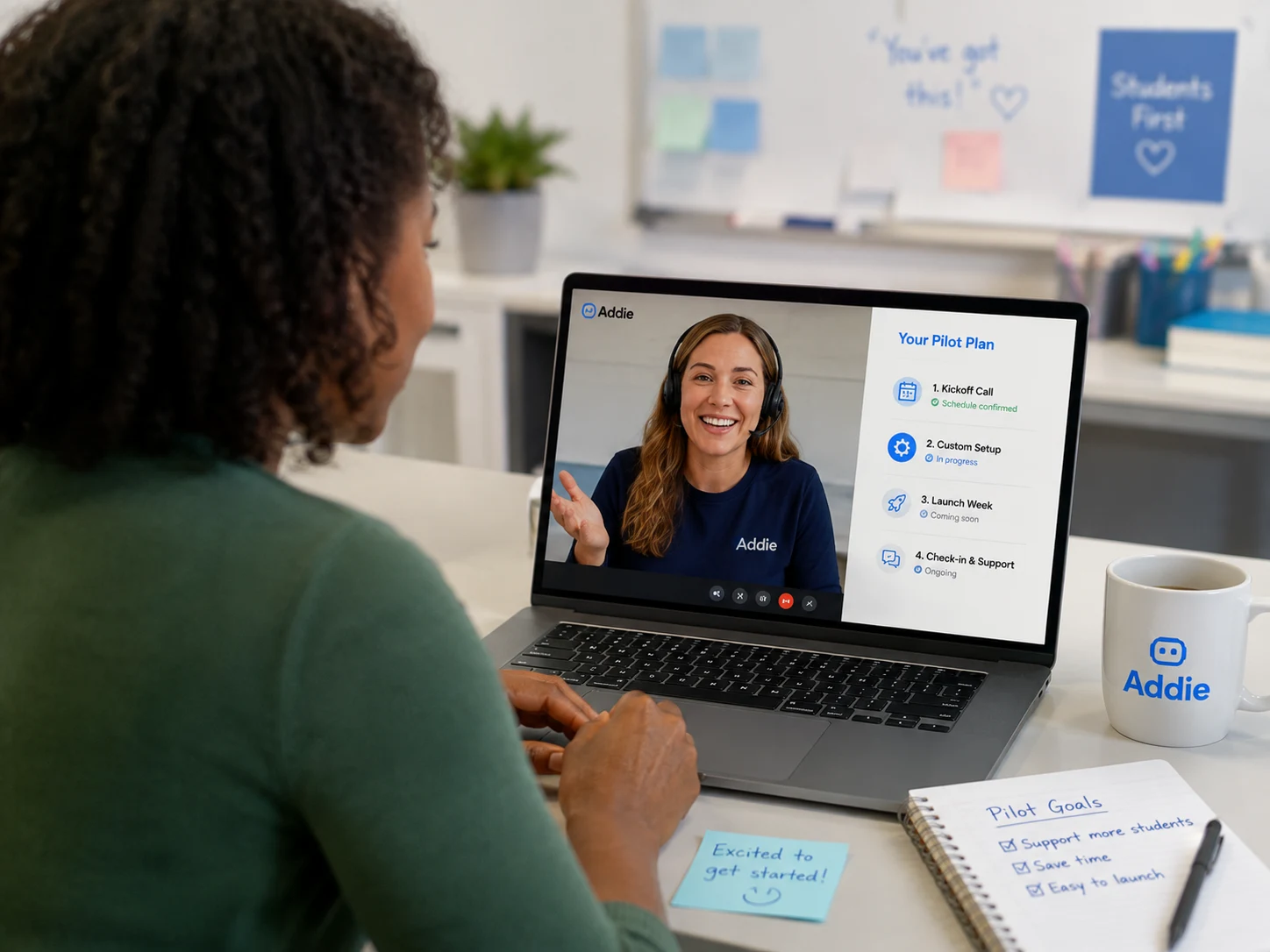
Give students dedicated time to reflect and explore. Give counselors connected context before the meeting. Addie arrives with proven grade-level journeys and launches like adding a deeply informed counseling assistant—without a training marathon, new curriculum, or IT project.
Students reflect and find better fit through guided voice or text conversations.
Counselors start prepared with a living Student Ledger, evidence, and next questions.
Leadership sees engagement and human impact instead of another unmeasured tool.
No new curriculumNo complex SIS project30-minute alignment
The cost of waiting
Schools do not need more software. They need a partner that helps counselors move earlier.
Students explain what matters, counselors see patterns across the cohort, and important meetings begin further ahead.
Join counseling teams already proving what changes.
Used by 70+ schools in the U.S. and internationally, including leading ACCIS schools. Your peers are already testing what changes when students reflect earlier and counselors start prepared.




600+ hoursstudent reflection captured at Lakeside
1 weekfrom UPrep setup to counselor use
50%+ lessrecommendation preparation reported at The Pingry School
What the pilot is designed to prove
A better student experience. A better-prepared counseling team.
A pilot is not open-ended access to experiment with AI. It is a structured way to see how Addie changes real student and counselor work at your school.
Students reflect and explore
Students get time to explain how they learn, what matters, what is changing, and where they may thrive—without waiting for the next scarce meeting.
- Voice or text, on their own time
- Better self-understanding and fit
- More complete student stories
Counselors start prepared
Addie connects student reflection with approved school context so counselors can begin meetings, recommendations, and planning work further ahead.
- Meeting preparation
- Stories and teacher evidence
- Targeted human follow-up
Leadership sees human impact
The school can see student engagement, counselor use, operational fit, and whether Addie is creating more room for relationships and judgment.
- Visible participation and depth
- Measurable counselor value
- Clear expansion decision
Why now
Most schools wait until the pressure is already on.
Without a scalable way to listen, teams reconstruct the student story too late, quieter students disappear into the caseload, and recommendation, fit, and support conversations begin with avoidable gaps. A pilot shows what changes when students reflect earlier and counselors enter important moments already prepared.
See whether your students and counselors are leaving value on the table.
Why counselors care
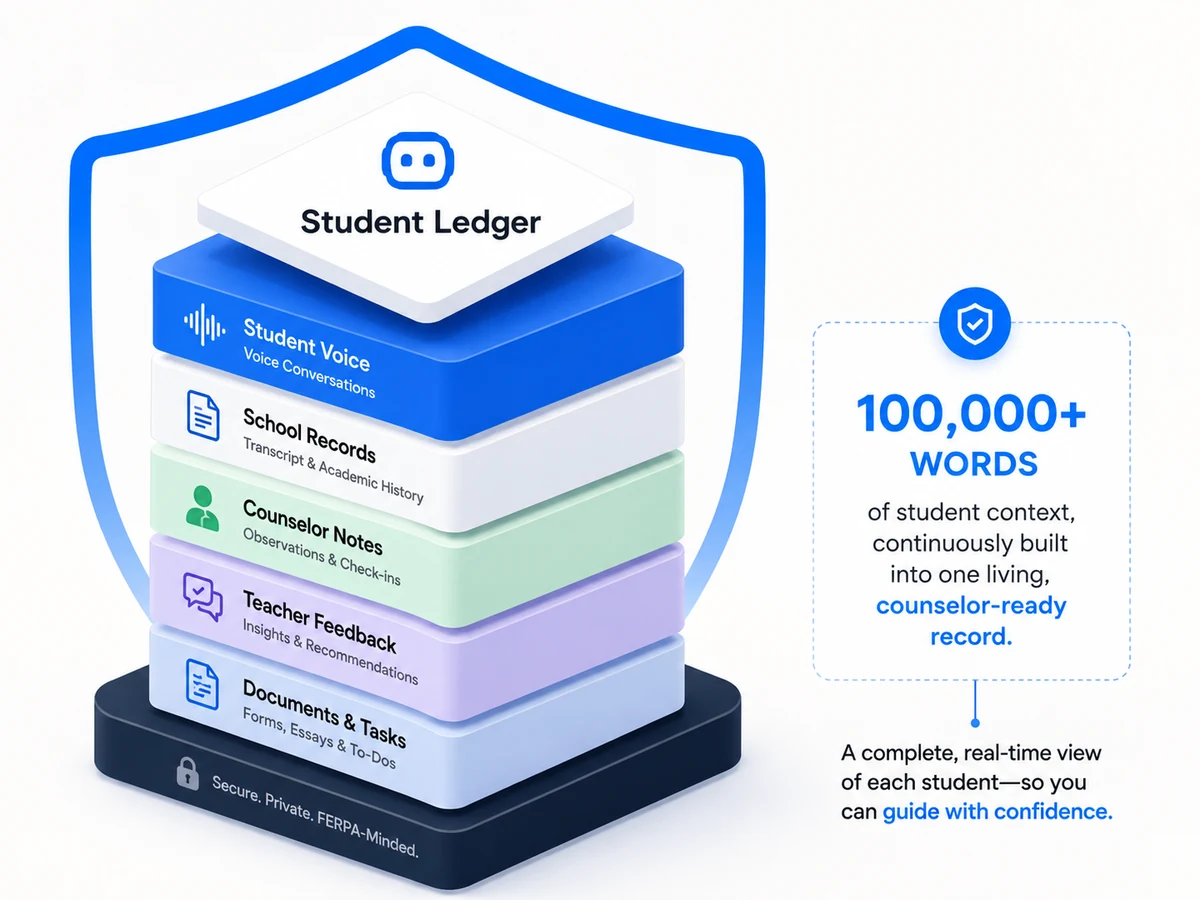
One Student Ledger. A steadily deeper record of the student.
Addie brings together student voice, counselor notes, teacher feedback, school records, and other approved context into one living record built for counseling—not just storage.
That means one student can accumulate toward 100,000 words of usable context over time, giving counselors a far more complete starting point for advising, fit, recommendations, and support.
It captures voice
Students can explain nuance, motivation, and change in their own words.
It compounds over time
Each check-in, teacher comment, and counselor note makes the record more useful.
It becomes counselor-ready
The ledger supports better meetings, stronger letters, and more confident follow-up.
The student experience
Six guided conversations. One steadily richer understanding.
Students choose voice or text, pause and return, and build context that becomes useful in counselor meetings, course planning, fit guidance, recommendations, and follow-up.
Voice or text
Pause and return
Multilingual where supported
Built for counselor use
Conversation 1
Starting Point
Addie introduces the experience, builds trust, and learns where the student is practically and emotionally in the process.
A question Addie might explore“What feels exciting, confusing, or unfinished as you begin this process?”
What the student works through
- What has already been researched or discussed
- What feels exciting, confusing, or unfinished
- Who is influencing the process
- What the student wants the counselor to understand
What the counselor gains
- A warm opening for the first meeting
- Immediate visibility into readiness and uncertainty
- One worry and one source of momentum
- Clarity about where to begin human follow-up
What this can replace or improve
A thin opening questionnaire or the first 15 minutes of a meeting spent reconstructing where the student is.
What the pilot can measure
Completion, depth of reflection, counselor usefulness, and whether the first meeting begins further ahead.
ResultEnough context to begin the first meeting warm, not cold.
Conversation 2
Academic Strengths
This is not a grades review. It helps the student explain how they learn, what motivates them, and what happens when the work becomes difficult.
A question Addie might explore“Tell me about a time you had to change the way you learned.”
What the student works through
- Where they feel capable and engaged
- How they respond to challenge
- When and how they ask for help
- A meaningful academic moment
What the counselor gains
- A learner profile behind the transcript
- Evidence of growth and resilience
- Better course and pathway context
- Specific recommendation material
What this can replace or improve
Course planning driven only by grades, requirements, and limited meeting time.
What the pilot can measure
Whether counselors discover useful learning context they did not previously have.
ResultA clearer picture of the student as a learner.
Conversation 3
Life Outside the Classroom
Activities become stories about responsibility, contribution, leadership, family roles, and growth—not another list of accomplishments.
A question Addie might explore“What do you do outside class that has shaped who you are—and why?”
What the student works through
- Activities, work, service, hobbies, and family roles
- Which experiences matter most and why
- Initiative, leadership, and invisible responsibility
- What they want to continue or change
What the counselor gains
- The person behind the activity list
- Values revealed through concrete moments
- Stories for recommendations and essays
- Context conventional forms often miss
What this can replace or improve
A brag sheet that records what happened without explaining why it mattered.
What the pilot can measure
Narrative depth, story usefulness, and the amount of counselor-ready evidence surfaced.
ResultA richer student story beyond the résumé.
Conversation 4
Future Path
Students can be curious, uncertain, or considering multiple paths. Addie connects interests to experiences without forcing an answer too early.
A question Addie might explore“What kinds of problems, topics, or environments could you imagine wanting to work with?”
What the student works through
- Fields, subjects, careers, or problems that feel compelling
- Why those directions appeal
- University, gap year, work, or multiple pathways
- Family, financial, geographic, and personal context
What the counselor gains
- What feels exciting or meaningful
- What is expected versus student-owned
- Where uncertainty remains useful
- Better questions for exploration
What this can replace or improve
Generic career inventories or meetings where students feel pressured to declare a direction prematurely.
What the pilot can measure
Student clarity, counselor usefulness, and whether pathway conversations become more specific.
ResultLanguage for what feels possible, meaningful, and unresolved.
Conversation 5
College Fit
Addie treats named colleges as examples of preferences—not recommendations—and helps the student define the conditions in which they may thrive.
A question Addie might explore“What parts of your current school experience would you want again—and what would you change?”
What the student works through
- Academic, social, geographic, and residential preferences
- Community, support, size, setting, and lifestyle
- What to repeat or change from high school
- Family, cultural, financial, and practical influences
What the counselor gains
- What “fit” means in the student’s own words
- Why named schools are appealing
- Which constraints shape the search
- A more grounded way to refine the list
What this can replace or improve
A spreadsheet of school names without a durable record of the reasoning behind them.
What the pilot can measure
Fit clarity, list quality, and how well the student can articulate what they are seeking.
ResultA student-defined picture of fit—not just a list of school names.
Conversation 6
Pre-Counselor Check-In
Before the human meeting, the student gets one more chance to share important circumstances, support, concerns, and changing priorities.
A question Addie might explore“What should your counselor understand before you walk into the meeting?”
What the student works through
- Important school, home, or life context
- Outside tutoring, counseling, or test preparation
- What they want noticed or emphasized
- How they feel heading into the meeting
What the counselor gains
- Context that could otherwise arrive late
- Support structures already in place
- What changed since the last interaction
- Where the human conversation should begin
What this can replace or improve
Cold meeting openings, last-minute surprises, and incomplete follow-up notes.
What the pilot can measure
Meeting preparedness, counselor confidence, and whether conversations feel less rushed.
ResultFewer surprises and a more prepared counselor conversation.
See how these conversations could fit your school calendar.
The counselor experience
See the right context before the moment it matters.
During a pilot, counselors should be able to see exactly where Addie changes the work—not just whether students logged in.
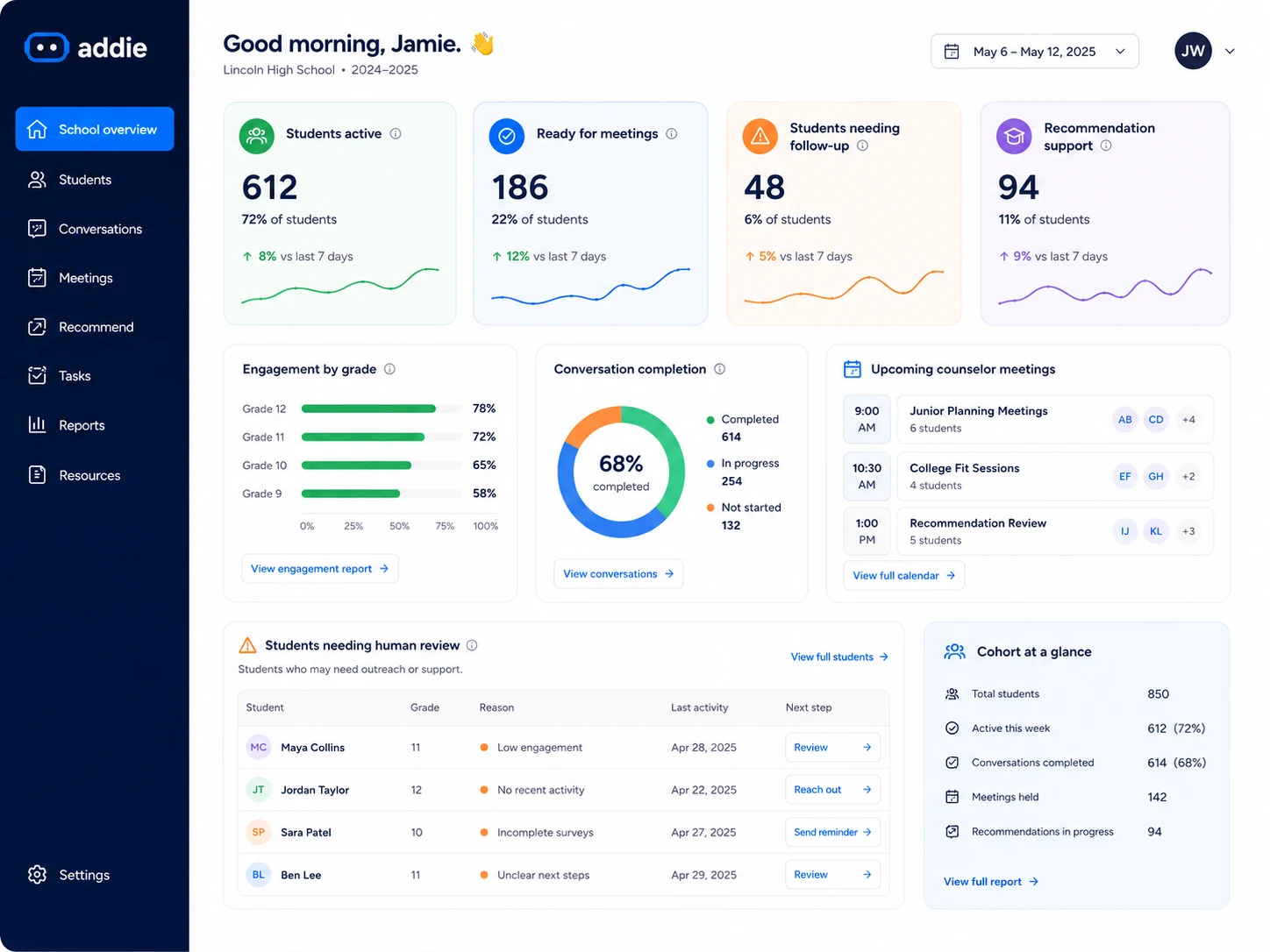
Meetings begin further ahead
See what changed, what the student wants understood, and where a human question could go deeper.
Recommendation work starts with evidence
Find stories, quotations, teacher comments, themes, and possible structure without rebuilding the student from scattered files.
The caseload becomes more visible
See who is active, stalled, ready, or signaling a need for human review.
The school can judge whether Addie is worth expanding
Measure engagement, counselor use, operational fit, and whether human counseling time improved.
Give students a better experience while counselors start further ahead.
Frictionless onboarding
Like adding a knowledgeable counseling assistant who arrives ready to work.
Addie brings proven journeys, launch materials, and counselor workflows. Your team provides the students, calendar, and school context. No training marathon or curriculum rebuild.
Name the champion and cohort
Identify the school lead, participating students, counselor assignments, and launch window.
Align for 30 minutes
Match Addie’s journeys, terminology, communication, guardrails, and deadlines to your program.
Provide a secure roster
Start with the smallest reliable dataset. Add approved questionnaires, comments, or records only when useful.
Addie configures and tests
Addie creates accounts, routes students, prepares school-owned messages, and validates the experience silently.
The school launches
Students engage around real school dates while Addie provides visibility, reminders, support, and an outcomes review.
The school provides
- A named champion and meaningful cohort
- A secure roster and counselor assignments
- School dates, terminology, and communication approval
- Counselor participation and an outcomes review
Addie provides
- Configuration, accounts, and proven conversation journeys
- Counselor alignment and student launch materials
- Engagement visibility, reminders, and support
- Evidence review and a recommendation for continuation or expansion
Low lift for the school. High signal for the leadership team.
Works with the program you already run
Choose the outcome that matters most to your team.
Addie can enter through the school workflow that creates the clearest student and counselor value—then the Student Ledger compounds across the rest of the program.
Junior intake
Replace thin, fixed responses with guided reflection and meaningful follow-up.
Course and pathway planning
Help grades 9 and 10 connect learning, interests, courses, and possible futures.
Counselor meeting preparation
Begin with context, better questions, and fewer surprises.
College fit and list building
Ground choices in the student’s values, learning, community needs, and constraints.
Recommendation preparation
Organize stories, teacher evidence, quotations, and structure while counselors retain authorship.
Milestones and follow-up
See who is engaging, who is stuck, and where human attention should go.
A pilot with a decision path
Make the value visible.
At the outcomes review, Addie and the school look beyond logins to determine whether the experience changed student reflection, counselor work, and human engagement.
Activation, conversation completion, return behavior, voice/text choice, and depth of reflection.
Profiles reviewed, meeting preparation, recommendation support, and useful new context surfaced.
Less-rushed meetings, targeted follow-up, better questions, and more counselor time applied to relationships and judgment.
Roster setup, school communication, counselor adoption, support burden, and fit with the school calendar.
Continue, expand to more grades, adjust the experience, or end—with a clear scope and next step.
Proof from peer counseling teams
The questions schools want answered have already been tested.
Will students engage?More than 600 hours of student reflection prepared counselors before meetings intensified.
“It made some meetings feel a lot less rushed.” — Ari Worthman
Will counselors adopt it?A counselor who initially resisted another tool said within a week, “I can’t do my job now without this.”
“This actually makes us more human.” — Kelly Herrington
Will it save meaningful time?Addie organizes evidence and structure for letters that normally require hours, while counselors remain the authors.
“We’re in it and using it and envisioning many ways. It’s only going to get better.” — Joe Kinney
Schools like Lakeside, University Prep, and The Pingry School are already using Addie to move earlier and prepare better.
School-controlled from setup to launch
Start safely without waiting for a perfect integration.
The school controls the cohort, enabled information, access, communication, and timing. Addie can begin with a secure roster and add deeper connectivity only when useful.
School-owned rollout
The school approves recipients, messages, timing, access, and support paths before any student is contacted.
Private, role-based context
Counselor notes remain restricted and student data is not used to train public models.
Human-reportable concerns
Addie can alert designated staff when a student interaction requires human review under the school’s agreed protocol.
Roster-first implementation
No complex SIS project is required. The systems your school already uses remain in place.
Frequently asked questions
What schools ask before reserving a pilot
The key questions counseling leaders ask before they commit a cohort and launch window.
Who should participate in an Addie pilot?
We recommend a meaningful student cohort—a grade, counselor caseload, or another group tied to a real school milestone. A few ad hoc accounts rarely show the full counselor value.
What do students do during the pilot?
Students complete guided voice or text conversations selected for the grade and school calendar. They can use phone, browser, WhatsApp, or text, pause and return, and build a Student Ledger over time.
What do counselors receive?
Counselors receive cohort-level visibility, counselor-ready summaries, meeting preparation, fit and pathway insight, recommendation support, and signals about who may need human follow-up.
How much work is required from our team?
The school names a lead, identifies the cohort, attends a 30-minute alignment meeting, provides a secure roster, approves communication, and participates in an outcomes review. Addie handles configuration, accounts, launch materials, visibility, and support.
Do we need a new curriculum or complex integration?
No. Addie arrives with proven journeys and works around counseling activities already on your calendar. A secure roster is enough for many pilots.
How quickly can we launch?
A roster-first launch can move quickly once the school identifies the cohort, communication path, and launch dates. The exact timeline depends on school approvals and roster readiness.
How is privacy handled?
The school controls participants, enabled information, users, access, communication, and timing. Student data is not used to train public models. Read the Privacy Policy.
What makes the pilot successful?
A strong pilot demonstrates meaningful student engagement, counselor use, deeper insight, stronger or less-rushed human interactions, operational fit, and a clear decision about continuation or expansion.
Reserve your launch window
See what changes when students have time to reflect—and counselors start prepared.
Submit the school form above and the Addie team will recommend the right cohort, launch timing, and next step for your counseling program.