
Ari WorthmanLakeside School
600+ hoursof student reflection captured
132 of 140 juniors completed the full ten-conversation journey before their counseling work intensified.
“It made some meetings feel a lot less rushed.”

AI college counseling platform · Grades 9–12 · Counselor-led
Students talk with Addie by phone, browser, WhatsApp, or text. Addie listens at scale and connects what they share with school context—so counselors know every student earlier, spend less time reconstructing the story, and guide better-fit choices.
More students heard. More counselor time for human guidance.
Used by 70+ schools in the U.S. and internationally, including leading ACCIS schools applying Addie to real student and counselor workflows.






132 of 140 juniors completed the full ten-conversation journey before their counseling work intensified.
“It made some meetings feel a lot less rushed.”

UPrep moved its required senior inventory into Addie and connected student voice, teacher comments, and counselor context.
“This actually makes us more human.”

Addie helps organize stories, evidence, quotations, and structure while the counselor remains the author.
“I’d say it’s cutting it at least in half, if not more.”
Students reflect. Addie connects the story. Counselors lead.
Addie creates time for students to explain what matters, then turns that context into better-prepared human counseling.
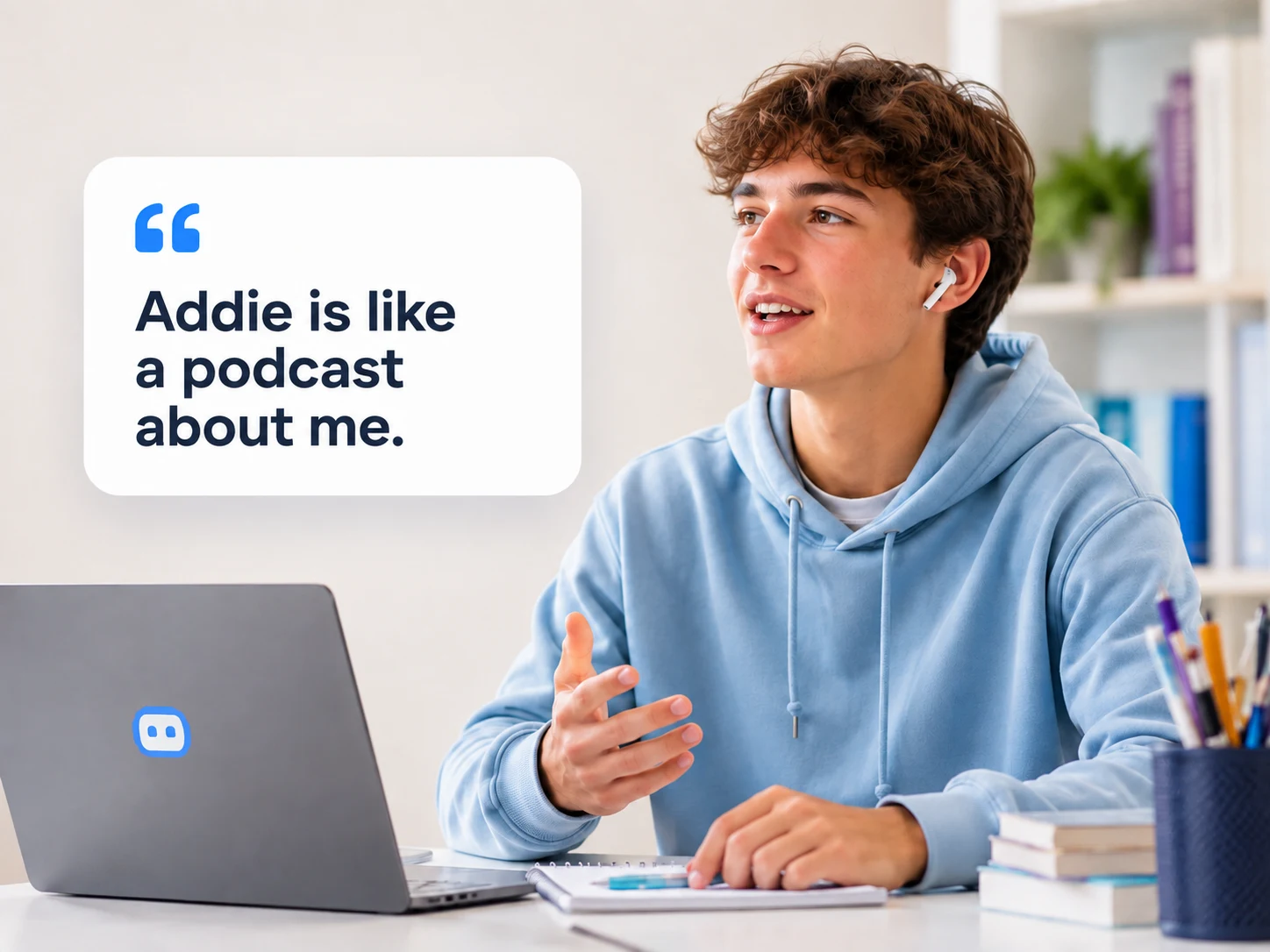
Addie handles scalable reflection and preparation so counselor time can move toward relationships, interpretation, judgment, and decisions.
Voice or text conversations happen when students are ready—and follow up beyond the first answer.
Student reflection joins teacher comments, counselor notes, questionnaires, and approved records.
Prepare meetings, guide better-fit choices, structure recommendations, and focus attention where it matters.
Students move beyond credentials to explain growth, values, interests, support needs, and where they may thrive.
Meetings begin with context, stronger questions, and fewer surprises—not another round of background collection.
Regular reflection helps counselors see changing priorities, support needs, and follow-up opportunities earlier.
Schools can see meaningful participation and counselor value—not just whether another tool was technically used.
The counselor payoff
One schoolwide view of who is engaging, who is ready, and where human attention should go next.
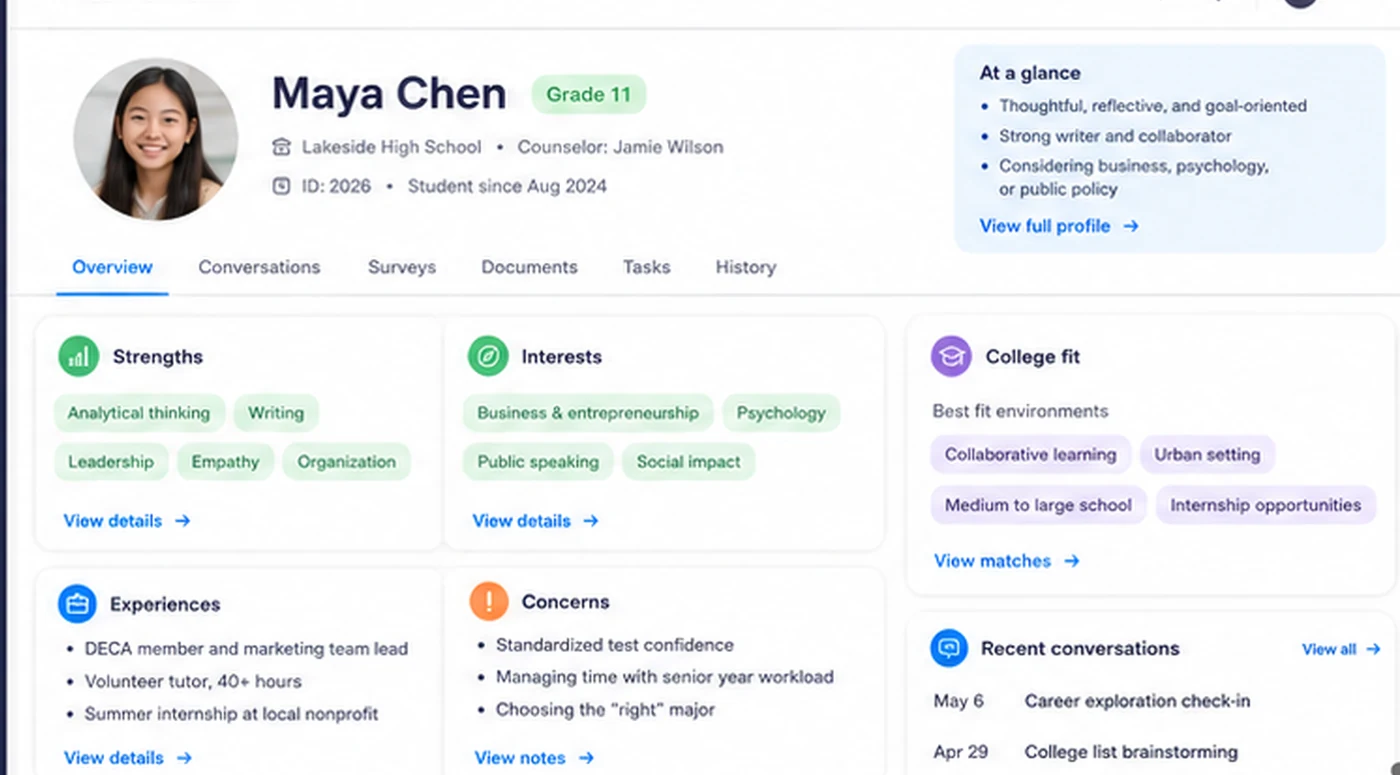
Addie gives counselors both the cohort-level visibility to manage a program and the student-level context to do the human work well.
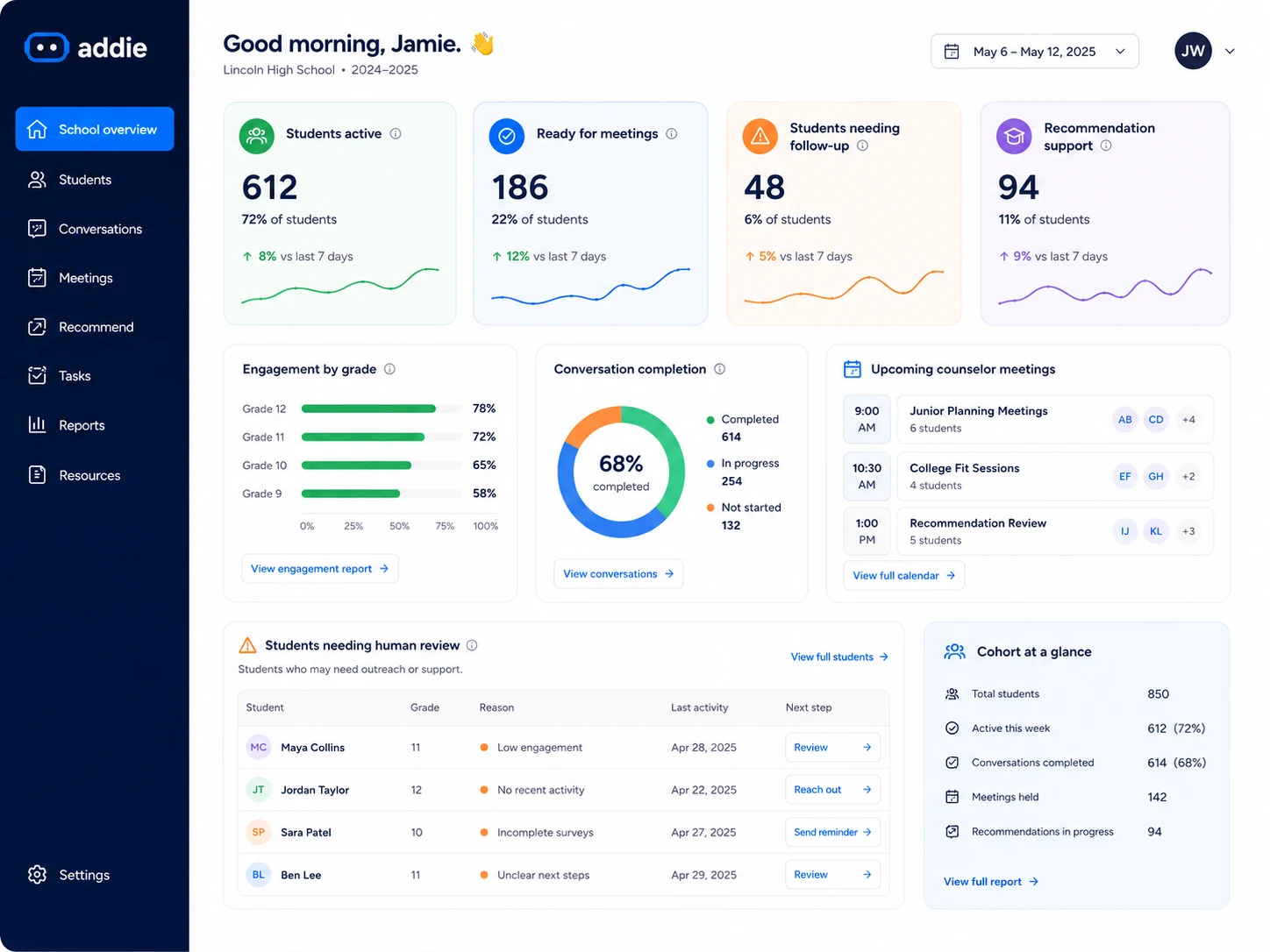
See who is active, stalled, ready for a meeting, or asking for support—without manually checking every student.
Know what changed, what matters now, and which questions are worth the student’s limited meeting time.
Move from scattered forms and notes to organized themes, quotations, teacher evidence, and possible structure.
Track engagement, conversation completion, upcoming priorities, and whether counselors are receiving useful context.
The core record
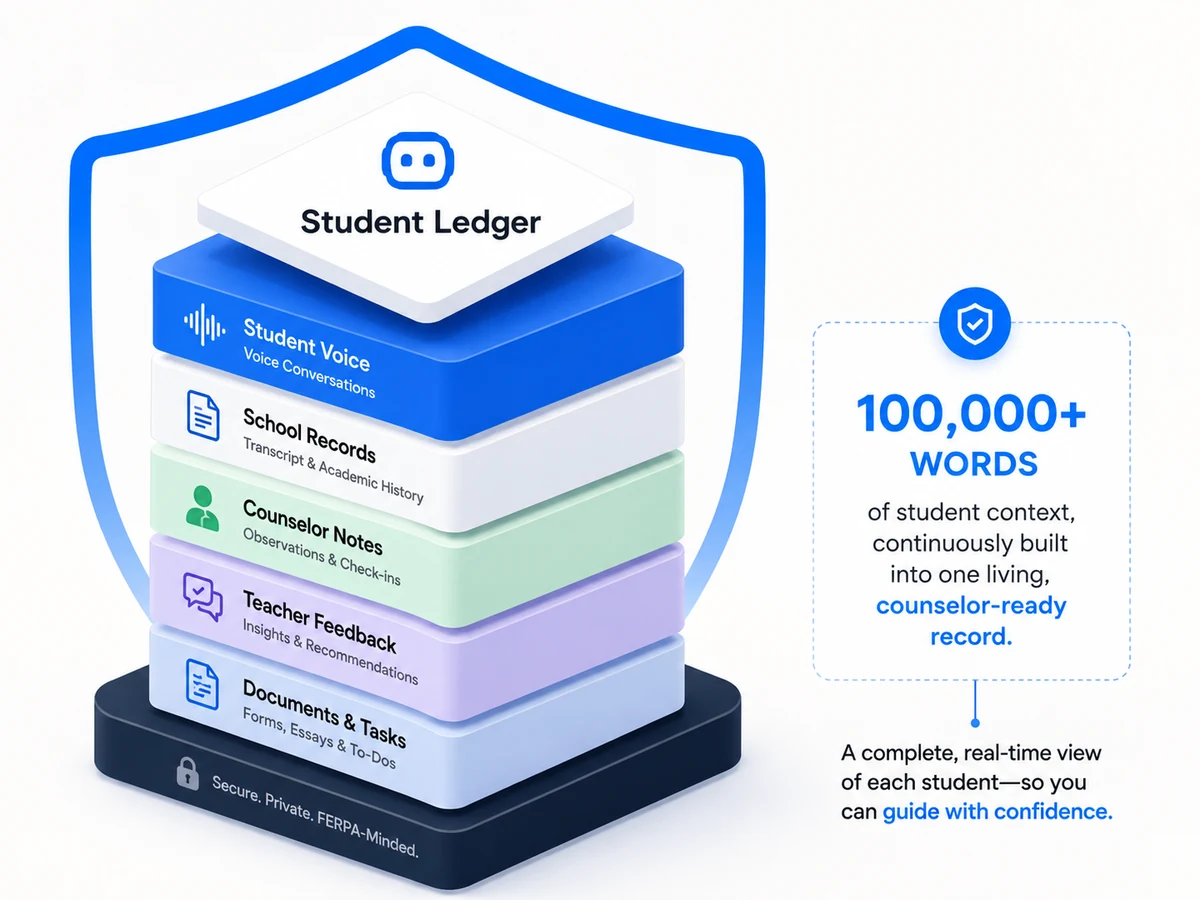
Instead of letting student voice, teacher feedback, counselor notes, and school information live in separate places, Addie steadily compounds them into one living record.
Over time, the ledger can grow toward 100,000 words of student context—organized so a counselor can use it for meetings, recommendation letters, course planning, college fit, and human follow-up.
Students explain how they learn, what changed, what matters, and what they want understood.
Comments and observations become usable evidence instead of isolated documents a counselor must reread.
Notes, meeting context, and next steps remain available across years, colleagues, and handoffs.
Approved records, tasks, and deadlines add practical context without replacing the systems your school already uses.
The combined record supports meeting preparation, better-fit decisions, recommendation work, and targeted support.
Built around the counseling calendar
You already have the work. Addie makes it richer, faster, and more connected.
Addie starts with the forms, meetings, notes, lists, letters, and deadlines your team already owns—not a parallel counseling program.
A static questionnaire often produces brief facts, credential lists, and answers the counselor still needs to unpack.
A guided voice or text journey follows up on why an experience mattered, what changed, and what the student wants understood.
Counselor outcome: richer context before the first major meeting.
Scarce meeting time is used to gather background, clarify forms, and remember what happened since the last conversation.
Students reflect beforehand and the counselor sees a concise brief, important changes, supporting evidence, and questions worth exploring.
Counselor outcome: a less rushed, more meaningful meeting.
Course choices are often driven by requirements and grades without enough time to connect learning style, interests, confidence, and future possibilities.
Students reflect before course-selection meetings on how they learn, what energizes them, and what junior- and senior-year choices may open.
Counselor outcome: more personal high-school planning that supports better postsecondary fit.
Preferences, research, school names, family priorities, and visit impressions live across spreadsheets, systems, and memory.
Fit criteria stay connected to years of student voice—learning environments, values, community, location, support, interests, and practical constraints.
Counselor outcome: choices grounded in where the student may truly thrive.
Counselors reassemble questionnaires, teacher comments, meeting notes, activities, family context, anecdotes, and prior drafts.
Stories, quotations, themes, teacher evidence, and possible structure are organized in one counselor-ready record.
Counselor outcome: faster preparation with judgment, voice, and authorship intact.
Email reminders, spreadsheets, and manual chasing make it hard to distinguish a student who needs a nudge from one who needs a counselor.
School-calendar tasks, engagement visibility, student check-ins, and targeted alerts help the team focus human attention where it matters.
Counselor outcome: less undifferentiated chasing and earlier, more relevant support.
Accomplishment lists give counselors the facts but often miss the meaning, responsibility, growth, and personal context behind them.
Guided reflection helps students explain the moments behind the line items—what they contributed, why it mattered, and how they changed.
Counselor outcome: stronger material for meetings, recommendations, and student-authored essays.
The student arrives with a blank page and scarce counselor time is spent excavating basic stories before meaningful workshop work can begin.
Student-owned themes, turning points, tensions, quotations, and possible directions are available before the human conversation.
Counselor outcome: a better workshop conversation while the student’s voice and authorship stay intact.
Comments, notes, and prior observations sit across systems and years, forcing counselors to reread and reconstruct the pattern.
Patterns in learning, contribution, growth, challenge, and direct teacher evidence stay organized in one counselor-ready record.
Counselor outcome: holistic context without another search through scattered documents.
Important context can remain in one person’s memory, get repeated in every family conversation, or disappear during counselor transitions.
Student voice, counselor notes, family context, and next steps stay connected and available to the authorized counseling team.
Counselor outcome: continuity across family conversations, team collaboration, and staffing changes.
Begin understanding students in ninth grade. Deepen that understanding every year. Use it when the most important academic, personal, and postsecondary decisions arrive.
Student voice, counselor knowledge, teacher input, school-approved information, and progress accumulate across grades 9-12.
Build the first meaningful understanding of the student’s transition into high school.
Connect learning, activities, identity, and possible futures before junior-year pressure begins.
Translate accumulated understanding into academic, college, career, and fit-based direction.
Use the full student story to support applications, decisions, and transition beyond high school.
The Conversation Journey
Students choose voice or text, pause and return, and build context that becomes useful in counselor meetings, course planning, college-fit guidance, recommendations, and follow-up.
Conversation 1
Addie introduces the experience, builds trust, and learns where the student is practically and emotionally in the process.
A question Addie might explore“What feels exciting, confusing, or unfinished as you begin this process?”
Conversation 2
This is not a grades review. It helps the student explain how they learn, what motivates them, and how they respond when the work becomes difficult.
A question Addie might explore“Tell me about a time you had to change the way you learned.”
Conversation 3
Activities become stories about responsibility, contribution, leadership, family roles, and growth—not just another list of accomplishments.
A question Addie might explore“What do you do outside class that has shaped who you are—and why?”
Conversation 4
Students can be curious, uncertain, or considering multiple paths. Addie connects interests to experiences without forcing an answer too early.
A question Addie might explore“What kinds of problems, topics, or environments could you imagine wanting to work with?”
Conversation 5
Addie treats named colleges as examples of preferences—not recommendations—and helps the student define the conditions in which they may thrive.
A question Addie might explore“What parts of your current school experience would you want again—and what would you change?”
Conversation 6
Before the human meeting, the student gets one more chance to share important circumstances, support, concerns, and priorities.
A question Addie might explore“What should your counselor understand before you walk into the meeting?”
The human outcome
Students get time to reflect. Addie prepares the context. Counselors use their limited time for relationships, interpretation, authorship, judgment, and decisions.
“It makes our students more reflective. It allows them to know themselves and be themselves.”
“Addie is another thought partner. It’s not replacing anything I would do.”
“We’re asking students to do this so we can help them. That’s, at the end of the day, what it’s all about.”
They have time to explain what matters in their own words.
The meeting starts closer to insight, not background collection.
Stories, teacher context, changes, and next steps stay connected.
Counselors interpret, author, advise, and lead the relationship.
Three respected independent-school counseling teams show how Addie supports real students, real meetings, and real recommendation work.
Lakeside School, University Prep, and The Pingry School are active Addie power users with different starting points and the same goal: more context and more room for human counseling.
Before: a static junior questionnaire. After: ten guided conversations and richer meetings.
“I didn’t initially think of AI as helping us get to know students better. It’s become fascinating to see how it can help with the qualitative parts of our jobs.”
“It probably cut my recommendations down from three to four hours to an hour and a half.”
Before: an existing senior inventory. After: a familiar workflow with deeper counselor context.
“One of the people who gave me the most pushback, within a week, said: ‘I can’t do my job now without this.’”
“What will I miss or overlook as a counselor that is secretly awesome about this student?”
Before: student evidence scattered across forms and notes. After: one daily counselor workflow.
“I’m not using it to write the letter. I’m using it to help me really structure the letter.”
“In the morning, one of the first places I go is Addie… ‘That means I can probably start her letter.’” — Amy Cooperman
Quotes lightly edited for clarity. Metrics reflect reported implementation use at the time of each conversation.
Safety is designed into the workflow
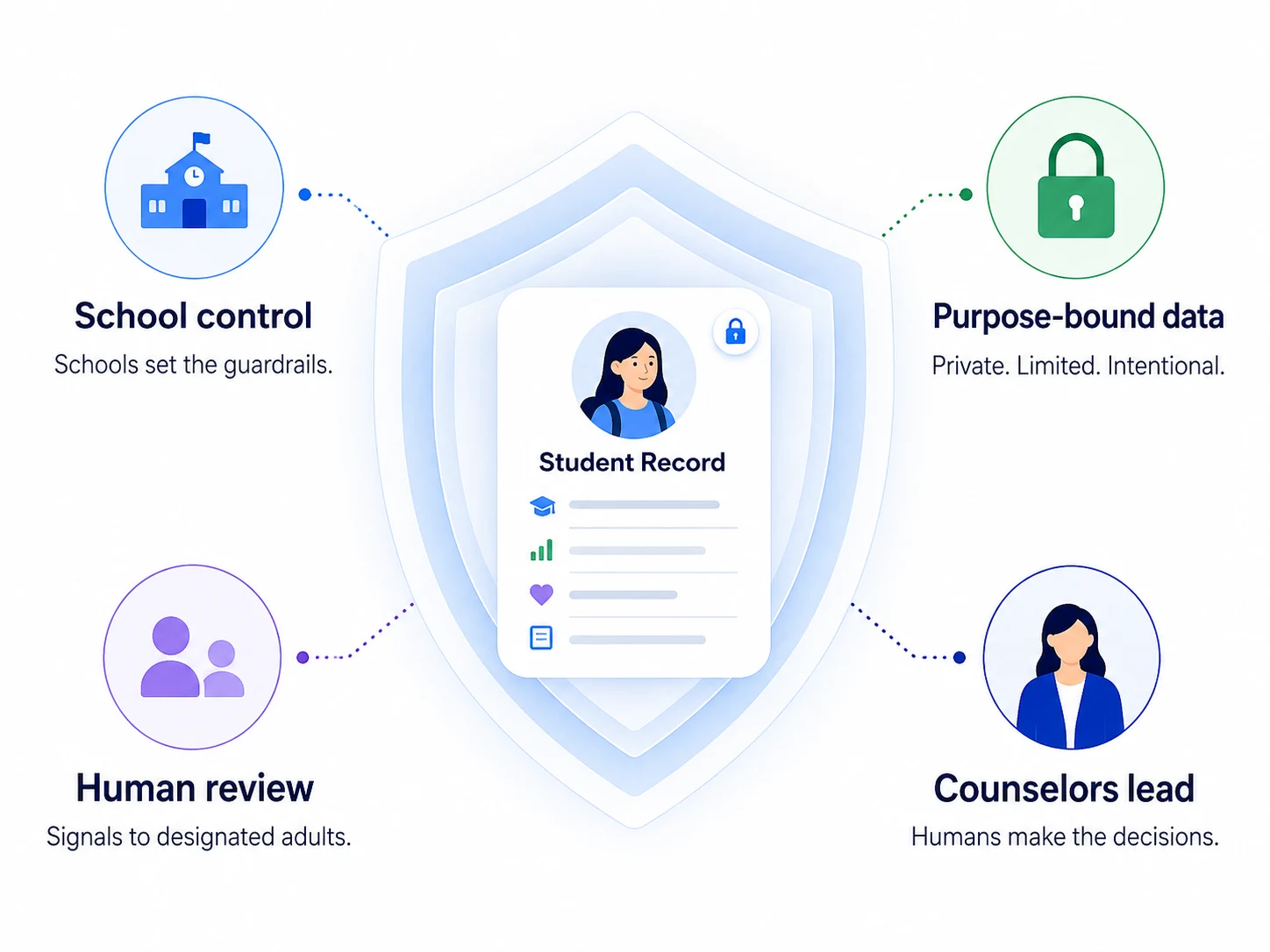
Built so schools can use AI without surrendering student privacy, counselor judgment, or control of the counseling process.
The school determines participating students, enabled information, users, communication, and launch timing.
Counselor notes remain restricted, access is role-based, and student data is not used to train public models.
Under the school’s agreed protocol, Addie can alert designated staff when an interaction needs human review. A trained adult decides what happens next.
Student-reported stress, belonging, confidence, relationships, or support needs can become visible for counselor follow-up. Addie is not therapy, clinical care, or emergency response.
Addie organizes, summarizes, and proposes. Counselors interpret, author, advise, decide, and lead the relationship.
Frictionless onboarding
Bring an always-ready counseling assistant onto the team—without a training marathon, curriculum rewrite, or months-long technology project.
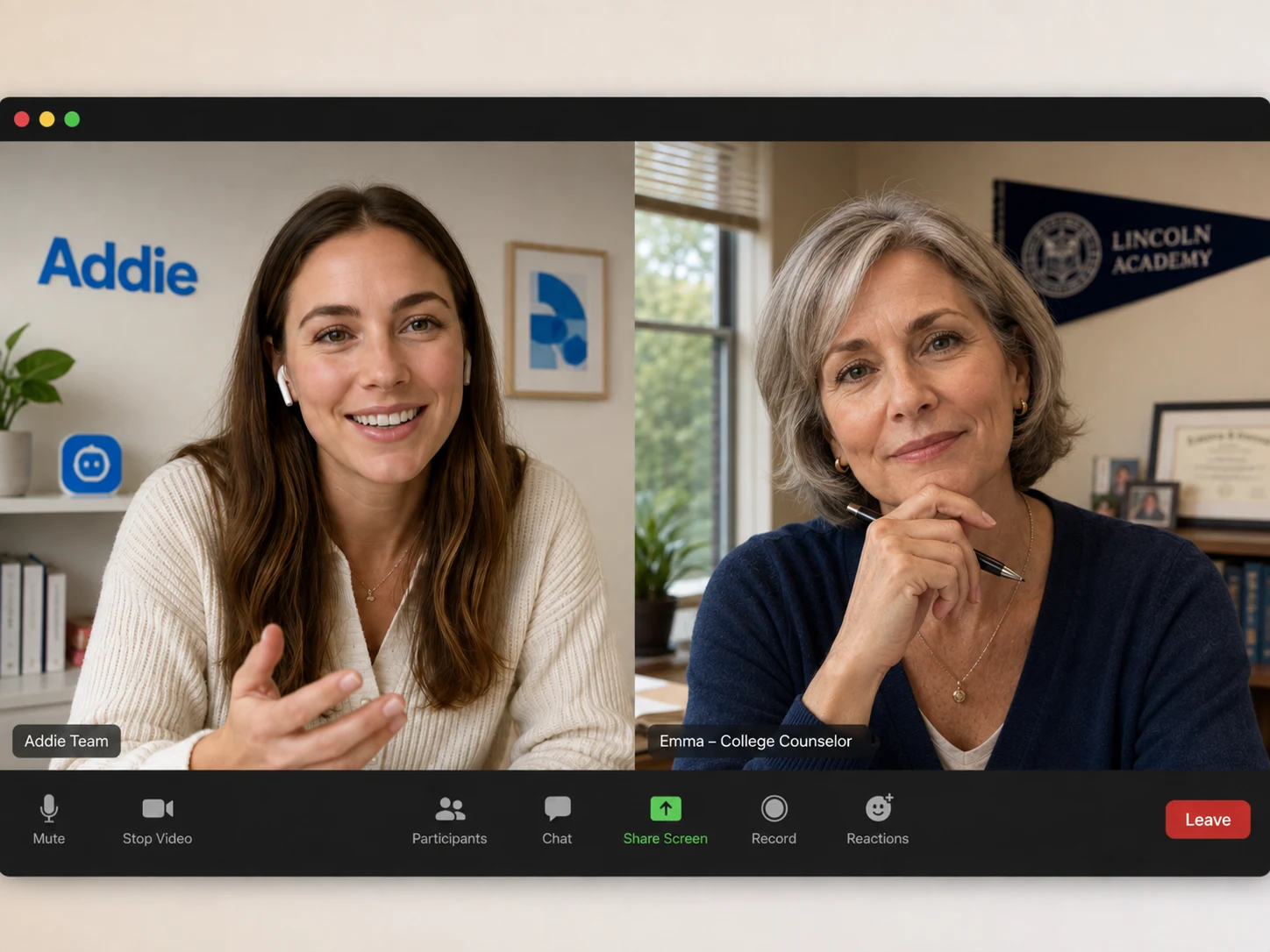
Addie comes with proven grade-level journeys and counselor workflows, stays available whenever students are ready to reflect, and keeps the student story organized between meetings.
One person coordinates the cohort, communication, and school calendar.
Select a grade, counselor caseload, or meaningful cohort.
Match proven journeys to your terminology, guardrails, and dates.
Addie configures accounts, supports the rollout, and makes engagement visible.
We will quickly map Addie to your students, calendar, and counseling priorities.
No platform fatigue
Addie works alongside the SIS and college-counseling platforms your team already uses. Start with a secure roster, reuse approved context, and deepen connectivity only when it creates real workflow value.

No rip-and-replace. No platform reset. Addie adds student reflection and counselor-ready context around the workflows already living in your school ecosystem. These logos identify systems Addie can work alongside; no partnership or endorsement is implied.
The fastest path for verified students, counselors, grades, IDs, and assignments.
Add transcripts, teacher comments, questionnaires, and approved records without a systems project.
Refresh rosters, assignments, and approved fields on an agreed cadence as deployment grows.
Go deeper only when scale, governance, or workflow value clearly justifies the added complexity.
A deeper integration is never required to begin safely.
Vendor names and logos are trademarks of their respective owners. No partnership or endorsement is implied. Technical paths vary by school configuration and approved access.
Choose the role closest to yours for the essential answers on this page - and the supporting PDFs to share in the next internal conversation.
See the student experience, counselor outputs, workflow improvements, and peer evidence that matter to a counseling director.
Understand the whole-high-school model, human-engagement outcome, evidence, pilot path, and commercial picture.
Review school control, data paths, access boundaries, launch safeguards, and the official policy language.
See the simple responsibilities, alignment meeting, roster setup, counselor preparation, student launch, and evidence review.
The questions counseling teams ask when deciding whether Addie is worth bringing into the program.
No. Addie gives students structured time to reflect, connects school-approved context, and prepares counselor-ready summaries. Counselors retain the relationship, interpretation, authorship, judgment, and every consequential decision.
At Lakeside School, 132 of 140 juniors completed all ten conversations and generated more than 600 hours of reflection. Strong school framing, a real deadline, and visible counselor use are central to engagement.
Counselors receive cohort-level visibility, a living Student Ledger, meeting preparation, recommendation support, fit insight, and clear signals about who may need human follow-up.
Yes. Regular reflection can surface belonging, confidence, stress, relationships, or support needs, and human-reportable concerns can be routed to designated adults under the school’s agreed protocol.
No. Most schools can begin safely with a secure roster and approved context. Deeper integrations are added only when they create useful operational value.
A roster-first launch can often move in days rather than months. The school names a champion and cohort, completes a 30-minute alignment session, approves communication, and launches around its existing calendar.
The school controls purpose, scope, cohorts, enabled information, access, and communication. Student data is not used to train public models. Read the Privacy Policy.
A strong pilot shows meaningful student engagement, useful counselor insight, stronger or less-rushed human conversations, operational fit, and a clear continuation or expansion decision. See the pilot page.
See where Addie fits your counseling program
In a 30-minute demo, we will map Addie to your students, calendar, and counseling priorities, then show exactly what students experience, what counselors receive, and how a frictionless pilot could begin.